Scott Morrison has declined to criticise Donald Trump’s contentious
travel ban, saying it is up to the United States to determine its border
control arrangements, and noting the rest of the world is now “catching
up” with Australia’s harsh deterrence policies.
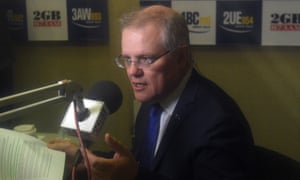
Morrison, a former immigration minister, suggested to Sydney radio
host Ray Hadley he empathised with the US president Donald Trump, who is
facing a fierce backlash against
his controversial executive order banning travel to the US from seven Muslim-majority countries.
“I remember when we came in in 2013 and I was implementing our border
protection policy people threw their hands up – and I said I’m doing
what I said I would do in the way I said I’d do it – and guess what, I’m
now getting the results I said I’d get,” Morrison told Hadley during
their weekly Monday morning chat.
“And we did that as a government, and we’ve continued that as a
government, and we are the envy of the world when it comes to strong
border protection policies.
“The rest of the world would love to have our borders and the way
they are secured and the immigration arrangements we have put in place,
particularly most recently, over the last three or four years.
“We’ve got a good history around this. Really, the rest of the world is catching up to Australia.”
Morrison refused to condemn Trump’s policy, which has sparked protests,
a legal challenge and criticism in the US and internationally.
Australia’s treasurer said Trump was doing what he said he would do
during the presidential race. “Now how the US wants to handle [border
protection] is a matter for them. As you say, they’ve had an election,
and the president is implementing what he said he would do.”
The foreign minister, Julie Bishop, has
reportedly indicated Australia will support Donald Trump’s “strong immigration and border protection policies”.
“The Australian government is working very closely with the
administration and the US officials and we want to ensure that
Australians continue to have access to the United States, as they have
in the past, and people from the United States have access to
Australia,” Bishop is reported to have said in Los Angeles.
The prime minister, Malcolm Turnbull, has not yet addressed the subject of the US travel ban.
In a call with the president at the weekend,
Turnbull secured Trump’s agreement to honour the deal to resettle refugees held on Manus Island and Nauru, which was negotiated under the Obama administration.
With the new political year opening with
another round of strategic sniping
by the former prime minister Tony Abbott, Morrison pointedly welcomed
this development as “an extraordinary achievement by Malcolm Turnbull”.
“[The prime minister] is very pleased we’ve been able to secure this
arrangement. They are both business people aren’t they, and a deal’s a
deal,” the treasurer said. “We are just getting on with it and Malcolm
is leading it.”
Labor’s deputy leader, Tanya Plibersek, was asked on Monday whether
the Trump travel ban was racist and said it was very important for
countries to maintain non-discriminatory immigration policies.
“I think that it’s very important that policies, immigration
policies, all government policies, are not based on race or religion or
ethnic background or country of origin,” Plibersek told reporters.
“Australia has had a non-discriminatory immigration policy for 40
years and that’s served us very well. We are stronger as a nation when
we are united. When we fight discrimination.
“Of
course, any country has the right to do background checks, to be
careful and cautious about who it invites to become a permanent resident
or a citizen.
“But flat-out discrimination based on religion or ethnicity or country of origin has never served us well.”
The One Nation leader, Pauline Hanson, has welcomed Trump’s move, but
questioned what Turnbull had to give to secure the new administration’s
backing for the refugee resettlement agreement.
“It seems like Australia might be getting a good deal on the resettlement of those housed on Manus and Nauru,”
Hanson said on her Facebook page. “But I would like to know what Australia had to promise in return because this deal won’t come without a cost.
“The question you should be asking yourself is pretty obvious: what are the real details of the deal?”