Our social:

Latest Post

Monday, 30 January 2017

Lung cancer and mesothelioma links be damned, Donald Trump thinks asbestos scare is a conspiracy


Believe Donald Trump, folks: There is an anti-asbestos conspiracy. In his 1997 book, The Art of the Comeback, Trump warned America not to buy the crusade against "the greatest fire-proofing material ever used." He claimed the movement to remove asbestos—a known carcinogen—was actually the handiwork of the mafia:
I believe that the movement against asbestos was led by the mob, because it was often mob-related companies that would do the asbestos removal. Great pressure was put on politicians, and as usual, the politicians relented. Millions of truckloads of this incredible fire-proofing material were taken to special "dump sites" and asbestos was replaced by materials that were supposedly safe but couldn't hold a candle to asbestos in limiting the ravages of fire.
Trump claimed asbestos is "100 percent safe, once applied," and that it just "got a bad rap." That, unsurprisingly, was a stretch. Asbestos can be safe, but only if it's in perfect condition and not shedding any fibers, which are toxic and can cause cancer. But the Occupational Safety and Health Administration says the asbestos often used in fireproofing will "readily release airborne fibers if disturbed"—and that there's "no 'safe' level of asbestos exposure for any type of asbestos fiber.”
Donald Trump thinks the push to remove the dangerous carcinogen known for causing lung cancer and mesothelioma was a mob-created conspiracy. Donald Trump, a man who doesn’t seem to give any thought to the health of the construction workers who build his skyscrapers and hotels, can be seen here singing the high praises of asbestos:

<iframe width="648" height="359" src="https://www.youtube.com/embed/sk3JUpDf5dk" frameborder="0" allowfullscreen></iframe>

Google and Apple join Silicon Valley voices condemning Trump's travel ban

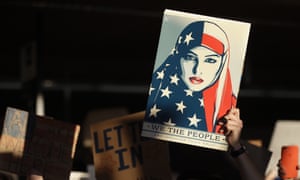
A protester holds a sign at San Francisco international airport during demonstrations against the executive order.
Leaders from some of Silicon Valley’s most prominent companies, including Google, Apple, Microsoft and Facebook, condemned Donald Trump’s executive order blocking travel from seven predominantly Muslim countries.
“It is time for tech companies to start speaking up about some of the actions taken by President Trump’s administration,” wrote Sam Altman, president of the influential startup incubator Y Combinator, in a blogpost.
“I am obviously in favor of safety and rules, but broad-strokes actions targeted at a specific religious group is the wrong solution, and a first step toward a further reduction in rights.”
The precedent of invalidating already-issued visas and green cards – which took place at airports across the US after Trump issued his executive order – should be “extremely troubling for immigrants of any country”, Altman wrote.
“This is not just a Muslim ban. This is a breach of America’s contract with all the immigrants in the nation.”
Aaron Levie, CEO of the enterprise cloud company Box, went further. “On every level – moral, humanitarian, economic, logical, etc – this ban is wrong and completely antithetical to the principles of America,” he wrote on Twitter.
Netflix CEO Reed Hastings used similarly strong language. “These actions will make America less safe (through hatred and loss of allies) rather than more safe,” he wrote on his Facebook page.
Comments from Apple, Google, Facebook and Amazon were more muted, but echoed the sentiment.
“I’ve heard from many of you who are deeply concerned about the executive order issued yesterday restricting immigration from seven Muslim-majority countries. I share your concerns. It is not a policy we support,” said Apple CEO Tim Cook in an email to employees, obtained by the Guardian.
Google issued a statement that said: “We’re concerned about the impact of this order and any proposals that could impose restrictions on Googlers and their families, or that create barriers to bringing great talent to the US.”
Google’s co-founder Sergey Brin took concrete action by showing up at San Francisco international airport, where thousands were protesting the executive order.
“As an immigrant and as a CEO, I’ve both experienced and seen the positive impact that immigration has on our company, for the country, and for the world,” said Microsoft CEO Satya Nadella in a LinkedIn post. “We will continue to advocate on this important topic.”
Facebook CEO Mark Zuckerberg said he was “concerned about the impact” of recent executive orders signed by President Trump.
“We need to keep this country safe, but we should do that by focusing on people who actually pose a threat. Expanding the focus of law enforcement beyond people who are real threats would make all Americans less safe by diverting resources, while millions of undocumented folks who don’t pose a threat will live in fear of deportation.”
The executive boards of some of the world’s fastest-growing companies show the contribution immigrants have made. According to a study by the National Foundation for American Policy, immigrants founded more than half (51%) of the current crop of US-based startups valued at more than $1bn.

Donald Trump's first 100 days as president – daily updates

  • Day 10

    Congressman John Lewis attends a demonstration against the Trump travel ban at Heartsfield-Jackson airport in Atlanta, Georgia. Photograph: Erik S Lesser/EPA
    Only a day after casting airports around the US into confusion, and hours after the administration's first defeat in federal court, Donald Trump and his advisers flew into a defense of his vague and chaotically enforced ban on travel from seven Muslim-majority countries. Chief of staff Reince Priebus appeared to concede to the courts by saying the ban would no longer apply to green-card holders, only to contradict himself within minutes. Meanwhile, attorneys told reporters “rogue” border patrol agents were still detaining people or trying to deport them. In a statement and a series of tweets, Trump insisted the order was not a “Muslim ban”, cited Obama precedents … and insulted John McCain, Lindsey Graham and the New York Times.
  • Day 9

    Protesters gather at JFK International Airport against Donald Trump's executive order. Photograph: Bryan R Smith/AFP/Getty Images
    Donald Trump’s executive order to close America’s borders to travellers from some Muslim-majority countries caused chaos and confusion, as multiple people who had flown to the US were held at major airports while others were barred from boarding flights or were pulled off planes overseas. As immigration and civil rights group scrambled to understand the order, and as family members of the stranded tried to contact their loved ones, a sizeable protest formed at JFK airport in New York. Trump spent the day in Washington, speaking to five world leaders including Vladimir Putin of Russia and issuing an executive order to ban members of his government moving swiftly to lobbying firms.
  • Day 8

    Demonstrators take part in a rally in support of Muslims and immigrants Friday in New York City. Photograph: Mary Altaffer/AP
    Marking a draconian shift in US policy, Donald Trump issued an executive order that will deny refugees and immigrants from certain Muslim-majority countries entry to the United States. Trump’s unprecedented action will indefinitely close US borders to refugees fleeing the humanitarian crisis in war-torn Syria and impose a de facto ban on Muslims traveling to the US from parts of the Middle East and North Africa by prioritizing refugee claims “on the basis of religious-based persecution”.
  • Since you're here …

    … we have a small favour to ask. More people are reading the Guardian than ever but fewer are paying for it. And advertising revenues are falling. The Guardian’s independent, investigative journalism takes a lot of time, money and hard work. If you help to support it, our future would be more secure
  • Day 7

    Donald Trump shakes hands at the fence upon his arrival at Andrews Air Force Base, Maryland. Photograph: AP Photo/Jose Luis Magana
    Mexican president Enrique Peña Nieto cancelled a visit to Washington, over Donald Trump's insistence that Mexico will pay for his border wall. Peña Nieto said: “Mexico reiterates its willingness to work with the US to achieve agreements which benefit both nations.” Speaking in Philadelphia, Trump claimed the decision to cancel was mutual. By the afternoon, Trump's press secretary said the president had decided to hit Mexico with a 20% import tax.
  • Day 6

    Donald Trump signs an executive order to start the Mexico border wall project at the Department of Homeland Security in Washington DC. Photograph: Nicholas Kamm/AFP/Getty Images
    Donald Trump faced a fresh torrent of criticism on Wednesday as he moved ahead with plans to build a wall on the Mexican border via executive order. Trump also signed an executive order that could slash funding for so-called “sanctuary cities”, and reinstated the “secure communities” program, which encourages broader cooperation between local law enforcement and federal immigration agencies.
  • Day 5

    Weathered flags fly in the Dakota Access Pipeline protest camp near Cannon Ball, North Dakota. Photograph: Terray Sylvester/Reuters
    Donald Trump was sharply criticised by Native Americans and climate change activists after he signed executive orders to allow construction of the Dakota Access and Keystone XL oil pipelines. Both pipe projects had been blocked by Barack Obama’s administration, partly because of environmental concerns. But Trump has questioned the science of climate change and campaigned on a promise to expand energy infrastructure and create jobs.
  • Day 4

    Donald Trump showing off one of his executive orders. Photograph: Ron Sachs-Pool/Getty Images
    Donald Trump began his effort to dismantle Barack Obama’s legacy, formally scrapping a flagship trade deal with 11 countries in the Pacific rim. The new president also signed executive orders to ban funding for international groups that provide abortions, and placing a hiring freeze on non-military federal workers.
  • Day 3

    Kellyanne Conway at the White House. Photograph: Andrew Harrer-Pool/Getty Images
    Rattled by the nation’s biggest political demonstrations since the Vietnam war, Donald Trump and his aides spent an extraordinary first weekend in office falsely claiming that record numbers of people had attended his swearing-in on Friday. Kellyanne Conway, a senior White House aide, told NBC press secretary Sean Spicer had been offering “alternative facts” when he made several statements contradicted by photographs and transit data.
  • Day 2

    Thousands attend the women's march on Washington. Photograph: Mario Tama/Getty Images
    The Women’s March on Washington descended on the US capital, while in hundreds of cities across America and around the world women joined in a gesture of resistance against the new president’s first full day in office – bringing a palpable sense of solidarity and determination to resist a backwards-looking agenda.
  • Day 1

    Donald Trump at his swearing-in ceremony as president. Photograph: Reuters
    Donald Trump coined the sinister phrase “American carnage” in his inaugural speech. But more chilling, some said, were the immediate changes to the White House website where Barack Obama's administration's information on civil rights, climate change, LGBT rights, healthcare, immigration, education and the “Iran Deal” all vanished. It changed to just six “issues” with, for example, “America first energy plan” replacing climate change.

Scott Morrison says Donald Trump travel ban shows 'world is catching up' to Australia

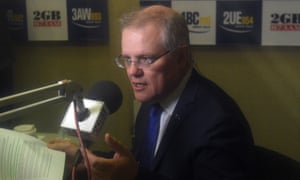
 Federal treasurer Scott Morrison at a radio interview
Scott Morrison has declined to criticise Donald Trump’s contentious travel ban, saying it is up to the United States to determine its border control arrangements, and noting the rest of the world is now “catching up” with Australia’s harsh deterrence policies.
Morrison, a former immigration minister, suggested to Sydney radio host Ray Hadley he empathised with the US president Donald Trump, who is facing a fierce backlash against his controversial executive order banning travel to the US from seven Muslim-majority countries.
“I remember when we came in in 2013 and I was implementing our border protection policy people threw their hands up – and I said I’m doing what I said I would do in the way I said I’d do it – and guess what, I’m now getting the results I said I’d get,” Morrison told Hadley during their weekly Monday morning chat.
“And we did that as a government, and we’ve continued that as a government, and we are the envy of the world when it comes to strong border protection policies.


“The rest of the world would love to have our borders and the way they are secured and the immigration arrangements we have put in place, particularly most recently, over the last three or four years.
“We’ve got a good history around this. Really, the rest of the world is catching up to Australia.”
Morrison refused to condemn Trump’s policy, which has sparked protests, a legal challenge and criticism in the US and internationally.
Australia’s treasurer said Trump was doing what he said he would do during the presidential race. “Now how the US wants to handle [border protection] is a matter for them. As you say, they’ve had an election, and the president is implementing what he said he would do.”
Advertisement
The foreign minister, Julie Bishop, has reportedly indicated Australia will support Donald Trump’s “strong immigration and border protection policies”.
“The Australian government is working very closely with the administration and the US officials and we want to ensure that Australians continue to have access to the United States, as they have in the past, and people from the United States have access to Australia,” Bishop is reported to have said in Los Angeles.
The prime minister, Malcolm Turnbull, has not yet addressed the subject of the US travel ban.
In a call with the president at the weekend, Turnbull secured Trump’s agreement to honour the deal to resettle refugees held on Manus Island and Nauru, which was negotiated under the Obama administration.
With the new political year opening with another round of strategic sniping by the former prime minister Tony Abbott, Morrison pointedly welcomed this development as “an extraordinary achievement by Malcolm Turnbull”.
“[The prime minister] is very pleased we’ve been able to secure this arrangement. They are both business people aren’t they, and a deal’s a deal,” the treasurer said. “We are just getting on with it and Malcolm is leading it.”
Labor’s deputy leader, Tanya Plibersek, was asked on Monday whether the Trump travel ban was racist and said it was very important for countries to maintain non-discriminatory immigration policies.
“I think that it’s very important that policies, immigration policies, all government policies, are not based on race or religion or ethnic background or country of origin,” Plibersek told reporters.
“Australia has had a non-discriminatory immigration policy for 40 years and that’s served us very well. We are stronger as a nation when we are united. When we fight discrimination.
Advertisement
“Of course, any country has the right to do background checks, to be careful and cautious about who it invites to become a permanent resident or a citizen.
“But flat-out discrimination based on religion or ethnicity or country of origin has never served us well.”
The One Nation leader, Pauline Hanson, has welcomed Trump’s move, but questioned what Turnbull had to give to secure the new administration’s backing for the refugee resettlement agreement.
“It seems like Australia might be getting a good deal on the resettlement of those housed on Manus and Nauru,” Hanson said on her Facebook page. “But I would like to know what Australia had to promise in return because this deal won’t come without a cost.
“The question you should be asking yourself is pretty obvious: what are the real details of the deal?”

Anti-Trump petition to prevent UK state visit passes 1m signatures

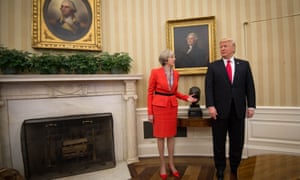
Donald Trump and Theresa May
An online petition calling for Donald Trump to be prevented from making an official state visit to the UK has reached 1m signatures.

The petition on the government’s official petitions site, which at one point was being signed by more than a thousand people each minute, quickly reached the 100,000 signatures needed to be considered for a debate in parliament.
However, Downing Street confirmed that Theresa May would not be withdrawing her invitation to the US president because it remained “substantially in the national interest”.
The petition, which falls short of calling for Trump to be banned from the UK, argues that he should not receive a full state visit including audiences with the royal family “because it would cause embarrassment to Her Majesty the Queen”.
The petition’s creators said: “Donald Trump’s well-documented misogyny and vulgarity disqualifies him from being received by Her Majesty the Queen or the Prince of Wales. Therefore during the term of his presidency Donald Trump should not be invited to the United Kingdom for an official state visit.”
As global condemnation of the controversial ban spread, British Conservative politicians joined the Labour party and Liberal Democrats in questioning May’s decision to go ahead with a state visit during which Trump would be courted by the UK government and royalty.
Jeremy Corbyn, the Labour leader, called for the visit to be suspended while Trump’s immigration ban is in place. He also questioned why May was so quick to invite the president given his highly controversial policies. “Donald Trump should not be welcomed to Britain while he abuses our shared values with his shameful Muslim ban and attacks on refugees’ and women’s rights.
“Theresa May would be failing the British people if she does not postpone the state visit and condemn Trump’s actions in the clearest terms. That’s what Britain expects and deserves.”
Tim Farron, the Liberal Democrat leader, in an interview on Sky News’s Sophie Ridge on Sunday, said the invite should be withdrawn and should never have been made in the first place. “What I am opposed to is Theresa May, when she should have gone over to the States to defend our corner and stand up to Donald Trump, has gone over and held his hand and is being seen now as giving him a royal audience in the United Kingdom,” he said.
Advertisement
“She should be standing up for British people and British interests, not going over there and tickling his tummy.”
Ruth Davidson, the leader of the Conservative party in Scotland, released a statement saying that state visits were designed “to celebrate and entrench the friendships and shared values” between their respective countries. Trump, she said, should not be welcomed to Britain “while a cruel and divisive policy which discriminates against citizens of the host nation is in place”.
Writing in the Guardian, Tory MP Sarah Wollaston said that while the state visit would be likely to go ahead, how it was done would provide an important “symbol”. She argued that Westminster Hall ought to be reserved for leaders who had made a lasting and positive difference to the world. “That does not include Mr Trump. No doubt there will be those who wish to fawn over him but that must not be from the steps of our nation’s greatest hall,” she said.
Parliament has already debated Trump once following a public petition about whether to ban the Republican presidential frontrunner from entering the UK after he originally floated the idea of banning Muslims from America. MPs described him as a “fool”, a “buffoon” and a “wazzock” in the lengthy parliamentary debate in January last year.
Last year’s petition calling for a second EU referendum following the vote for Brexit, was the largest parliamentary petition on record. It was signed by over four million people.
In addition to the anti-Trump petition, campaigners from groups including Stand Up to Racism are planning to organise “the biggest demonstration ever” to coincide with the US president’s visit.
On a Facebook event page, organisers said: “The invitation to Donald Trump for a state visit will be opposed by millions in Britain. Our government should not be seen to be endorsing the sorts of ideas and policies he is putting forward. We are committed, along with other campaigning organisations including Stop the War, People’s Assembly against Austerity and CND , to oppose this visit and to organise mass protests if it takes place.”
Downing Street was asked for a response to the calls to cancel his state visit. A spokesman said: “We extended the invite and it was accepted.”
Buckingham Palace has declined to comment.